
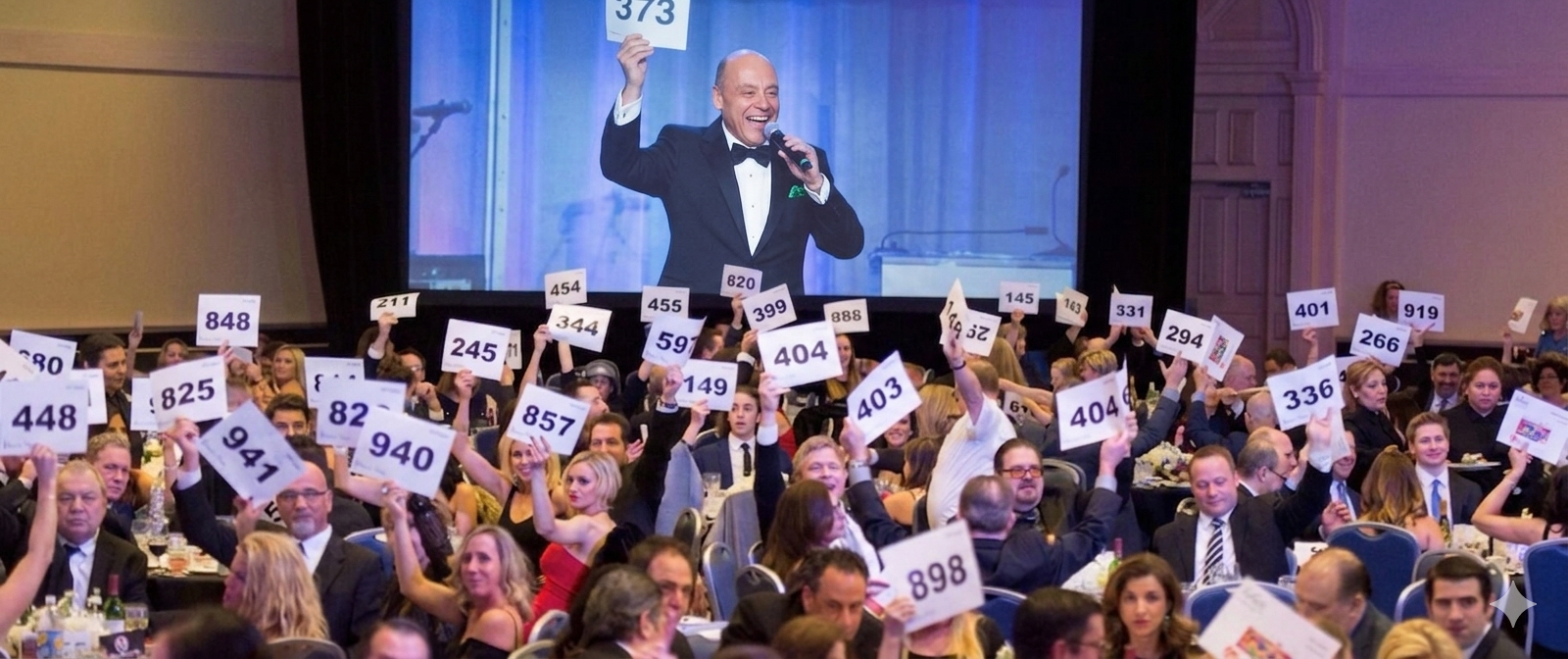
If you’re planning a nonprofit gala, hiring a professional charity auctioneer may be one of the most important financial decisions you make.
The right auctioneer can dramatically increase gala revenue.
The wrong one can stall momentum in minutes.
Before you book your next fundraising event, here are 10 critical things every nonprofit should know.
1. A Charity Auctioneer Should Be a Revenue Strategist — Not Just Entertainment
Energy is important.
But energy without strategy does not raise money.
A true nonprofit fundraising auctioneer helps design the revenue plan, structure the evening, and maximize every giving opportunity — not just “bring excitement.”
2. Revenue Planning Starts 60–90 Days Before the Event
If your auctioneer only shows up the week of the gala, that’s a red flag.
A professional should help define:
Net revenue goals
Revenue mix (tickets, sponsorships, auction, paddle raise)
Live auction placement
Emotional pacing
The live auction may last 20 minutes.
The strategy behind it takes months.
3. Auction Item Order Impacts Bidding Psychology
In a live auction, order is everything.
Every item should serve a purpose:
Warm-up item
Competitive driver
Premium showpiece
Emotional transition into Fund-a-Need
If items are randomly ordered, momentum drops — and so does revenue.
4. Bid Increments Can Increase (or Decrease) Thousands of Dollars
Bid increments are not arbitrary.
Too small → bidding slows.
Too large → donors hesitate.
Strategic calibration based on donor capacity can increase auction revenue without adding a single item.
5. The Paddle Raise Often Outperforms the Live Auction
Many nonprofits underestimate the power of a strong paddle raise strategy.
When structured correctly, the Fund-a-Need can generate more revenue than the auction itself.
It requires:
Compelling storytelling
Clear giving tiers
Leadership gifts pre-identified
Intentional pacing
The paddle raise is the emotional peak of the night.
6. A Professional Auctioneer Reads the Room in Real Time
No two galas are the same.
A skilled charity auctioneer adjusts tone, pacing, humor, and pressure based on:
Room energy
Donor behavior
Sponsor engagement
Competitive tension
This cannot be scripted.
It requires experience.
7. The Run of Show Determines Revenue Outcomes
If the auction follows a long awards presentation…
If the Fund-a-Need happens after dessert and guest fatigue…
If the room resets at the wrong time…
Revenue suffers.
A professional auctioneer helps architect the evening so momentum builds — not stalls.
8. Emotional Beats Matter More Than Retail Value
Donors do not give because of fair market value.
They give because of:
Identity
Impact
Community
Momentum
A strong auctioneer knows how to create emotional alignment — not transactional selling.
9. The Work Doesn’t End When the Gavel Drops
High-performing nonprofit events include:
24-hour donor follow-up
Impact reporting tied to giving levels
Identification of major gift prospects
Post-event momentum planning
The auction should be the beginning of deeper relationships — not the end.
10. The Right Auctioneer Protects Your Revenue Moment
Your gala may represent months of planning and a significant percentage of your annual fundraising.
When the live auction begins, you are compressing your revenue opportunity into a short, high-stakes window.
A professional charity auctioneer understands:
Donor psychology
Competitive bidding strategy
Paddle raise structuring
Emotional pacing
Revenue optimization
The microphone is visible.
The revenue architecture behind it is what truly increases gala revenue.
If you’re evaluating auctioneers for your next nonprofit fundraising event, don’t just ask about energy or personality.
Ask about:
Revenue strategy
Paddle raise performance
Run-of-show planning
Post-event stewardship
Because when structured correctly, those 20 minutes on stage can transform your entire fiscal year.